Tuesday, 8 March 2016

Comparing popular 80C investment options to save income tax

Comparing popular 80C investment options to save income tax

There are various options to save tax under section 80C of the Income Tax Act. But,one of them is better than the others.
Comparing some of the most popular 80C investment options.
elss with disclaimer
What are ELSS funds?
They are open-ended equity mutual funds that are eligible for tax deductions under Section 80C of the Indian Income Tax Act. They have the dual advantage of growing your wealth in addition to saving tax.
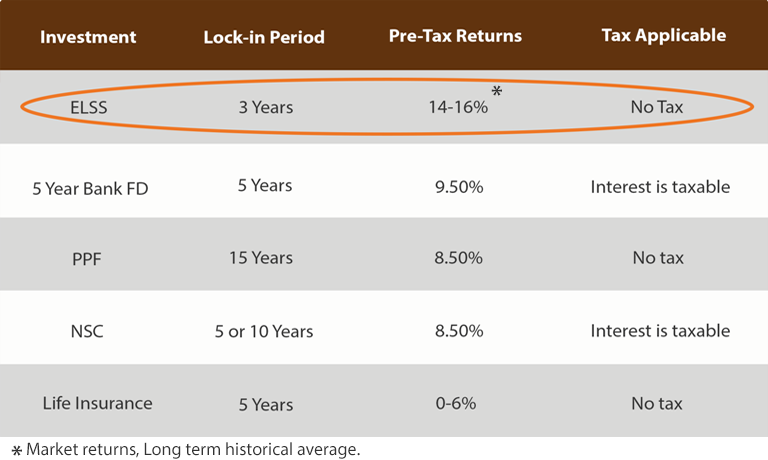
ELSS funds provide the best combination of
  • Potential for Long term inflation beating returns (14-16%)
  • Lowest lock in period (only 3 years) among all 80C investments and
  • Zero tax on your income from investment
Like all equity funds, the returns on ELSS funds are not guaranteed but this is the historical average for long term investments in ELSS funds.
How to invest in ELSS funds?
At Scripbox, using our scientific algorithm, we carefully select ELSS funds with the best long term prospects for you.
button 1
How will my money grow by investing in ELSS funds?
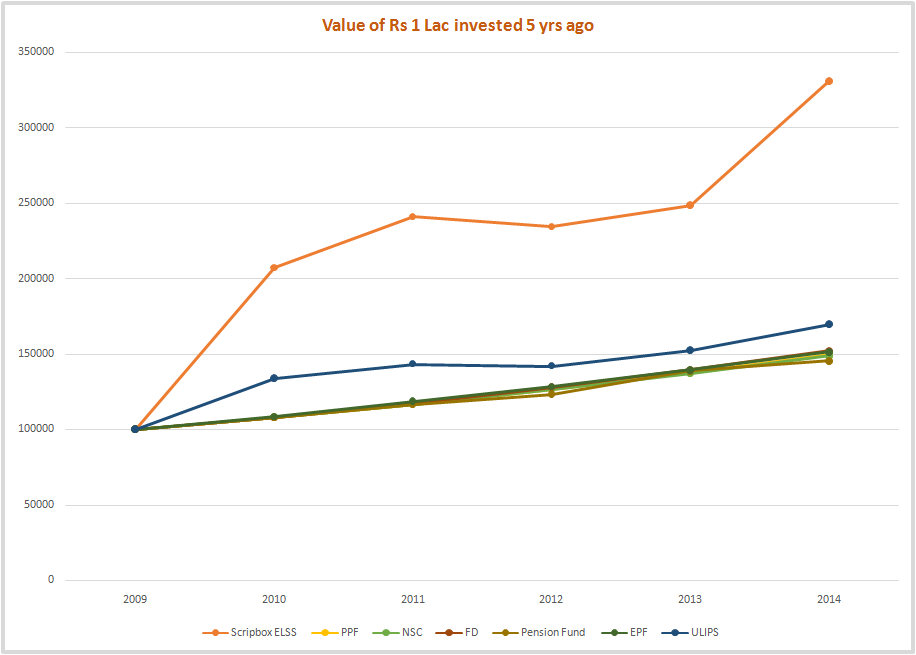
Careful ELSS fund selection can help you grow your wealth quickly compared to other 80C investment options.
elss 1
ELSS funds potentially give you inflation beating returns (14-16% historical long term average), which help you grow your wealth in addition to saving tax.

No more excuses! 11 Tax-Saving Options that Save Tax and Grow Your Wealth

No more excuses! 11 Tax-Saving Options that Save Tax and Grow Your Wealth

No-more-excuses!-11-Tax-Saving-Options-that-Save-Tax-and-Grow-Your-Wealth
In this world nothing can be said to be certain, except death and taxes”- Benjamin Franklin.
If you are reading this, you are likely to be someone whose income exceeds the threshold of Rs 2.5 lakhs for paying taxes. There are some legitimate ways of saving taxes and the good thing is that most of them also help you grow your wealth. These options usually have a lock in period and vary in the nature and amount of return they provide. You must also remember that each of these alternatives also serve specific purposes and tax saving is not the purpose but an ancillary benefit of that.

Comparing the different options

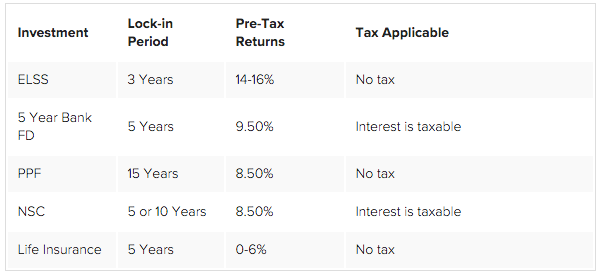
Summary: The best way to look at the various 80C investment options is to see what is pre-determined and what is optional. EPF, Home Loan repayment and Tuition Fees are pre-determined. Add them up and see how much of your 1.5 lakh limit is utilised. Use the below table to decide where you want to invest the rest.
Based on your risk appetite and expected returns, you can choose a product that’s best suited for your situation.
What does Scripbox recommend?

  • ELSS Mutual Funds – For people who want superior returns and also have higher risk appetite
  • PPF – For people who want returns at par with inflation and have very low risk appetite
elss investmentFor a more detailed understanding of the most popular tax saving investment options, please read our detailed review below.
ELSS Tax Saving Mutual Funds
ELSS or Equity Linked Saving Schemes, are a kind of equity linked mutual funds.  As they invest in equity or stocks, ELSS funds have the ability to deliver superior returns - 14-16% over the long term. That’s a full 6-8% above inflation.This return is not guaranteed though but historical evidence suggest that these returns are achievable over the long term.
ELSS funds have a lock in period of only 3 years – the lowest amongst the options available. The return from ELSS funds is also tax free.
You can investup to Rs 150,000 in ELSS funds either as a lump sum or on a monthly basis (SIP) thereby spreading your investments over the course of the year. The latter also helps in reducing volatility that’s typical of equity linked products.
You can invest in these mutual funds through an advisor or an online portal like Scripbox.
Public Provident Fund
PPF is a good option if you are looking for an option with certain returns.
Your PPF investments earns interest at a rate announced every year – currently 8.7%. PPF return is therefore mostly at par with inflation. However, it is tax-free and you can do a lump sum or small regular investments.
The duration of a PPF account is 15 years which is extendable by 5 years at a time. You cannot withdraw money from your PPF account except under certain conditions but not before 5 years.
You can invest in PPF through a bank or Post Office. Ability to invest online is limited.
5 Year Bank FDs
This is a variant of the regular Bank FD with a 5 year lock in. They offer slightly higher interest rates compared to normal FDs (0.25-0.5% higher) but does not offer liquidity option- even premature withdrawal with penalty is not possible.
The amount you can invest is limited to Rs 1,50,000. The interest you earn on your 5 year bank FD is fully-taxable and you will have to pay taxes on a yearly basis for the interest you earn for that period. TDS typically collected by banks is only 10% (20% in case you have not submitted your PAN) and if you happen to be in the 20 or 30% tax bracket, you need to pay the remaining interest while filing your IT returns.
Post-tax, 5 year bank FDs are not particularly attractive- especially for people in the 20 and 30% tax brackets since the post-tax returns (6-7%) are typically lower than other tax saving investment options.
National Savings Certificate (NSC)
NSC interest rates are fixed in April every year. The current rate is 8.5% for 5 year lock-in NSCs, and 8.8% for 10 year lock-in NSCs.
The interest accumulated is fully taxable. However, one key difference here is that the interest amount is not paid out to the investor. Instead, it’s re-invested in NSC and therefore can be considered as your investment in NSC for the subsequent year. Needless to say, this is complex.
Investments up toRs 150,000 are eligible. You can invest in NSC via your local post office.
Life InsurancePremium
This was almost the default tax saving option for years However, over the last few years, most informed investors have learnt the perils of choosing this option
There are 2 kinds of Life Insurance Policies:
  • Pure risk also called term life which ensure a risk to the life of the insured
  • Risk+ investment: which pay you back money over time
While pure risk life insurance is something everyone with a dependant must have, it’s not an investment. Life insurance is an expense- something you pay to ensure that your dependents are not left stranded should something unfortunate happen to you. Term life insurance is cheap and for a sum of about Rs 10000, you can purchase a cover of Rs 1 Cr
The returns from and costs of investment oriented insurance policies are not transparent and usually not attractive. We won’t go into length on this topic but suffice to say that you should not consider Life Insurance as a tax saving investment option.
National Pension Scheme
National Pension Scheme is a lot like investing in mutual funds with its Safe, moderate and Risky options. The returns are not guaranteed.
You cannot withdraw until 60 and the corpus amount must necessarily be invested in an Annuity. The withdrawals are also taxable.
Contributions up toRs 150,000 are eligible for deduction under Sec 80C. You can invest via the specified list of NPS fund managers with points of presence operated through banks.
However, given the restrictions that come with NPS, it’s not a recommended option.
Pension Funds
Pension funds are designed to provide you an income stream post retirement. They come in two flavours: Deferred Annuity and Immediate Annuity.
For deferred annuity plan, you invest annually until your retirement. Once you reach your retirement, you have can withdraw up to 60% of your accumulated corpus and have to re-invest the remaining in an annuity fund which will give you a monthly pension.
When it comes to immediate annuity plans, you invest a bulk amount one-time and get monthly pension from the next month itself. You would typically use these to invest your retirement corpus.
Pension funds are not very popular because of the sub-par returns (around 6%) that they give and the restriction they come with. That’s less than India’s inflation rate and not even half of what ELSS funds provide in the long run.
Pension funds are offered by a number of providers. Contributions up toRs 150,000 are eligible for deduction.
Senior citizens savings scheme
The senior citizens savings scheme is a product aimed at senior citizens to save tax. It can only be opened by people who are above 60 years old.
There is a maximum cap of 15 lakhs and a lock-in period of 5 years. You may withdraw the money before subject to penalty as follows
  • More than 1 year but less than 2 years – 1.5% of deposit amount
  • More than 1 year but before maturity – 1 % of deposit amount
This scheme is offered via the post office. Investments up toRs 150,000 are eligible.
EPF (Employee Provident Fund)
For salaried employees, this is not necessarily an optional thing. You will need to follow your company’s policy with some leeway available. However, a lot of people forget that the amount contributed to EPF is also eligible for 80C deduction.
EPF is typically deducted from your salary every month and it includes 12% of your Basic salary + DA up to a maximum limit of INR 6500 per month (inclusive of the optional matching employer contribution).
You can withdraw EPF when you change jobs. However, your accrued amount will be taxed as other income. If you withdraw EPF after 5 years, you do not attract any tax. Withdrawal after 5 years is based on qualifying criteria.
The interest rate varies every year (for e.g. interest rate in 2010-11, was 9.5%, while in the previous five years it was 8.5%). For 2014-15, the interest rate is fixed at 8.5%.
Other Tax Saving Investments & Expenses
Apart from voluntary contributions we make, there might be some forced savings/ expenses that already qualify for tax saving.
Tuition Fees for Children: Tuition fees for up to 2 children are covered under section 80C. Please note that it convers tuition fees only and not development fees or donations.
Home Loan Principal Repayment: You are eligible for tax exemption for the repayment you make towards your home loan principal. Do note that the interest component is not eligible for tax benefits.
The scripbox recommended portfolio of tax saving ELSS funds will help you invest in the ELSS funds with the best prospects and also provide you the convenience of online investing and tracking.
Please note that this article does not attempt to be a comprehensive tax saving guide, only a listing of the most common alternatives. Other alternatives include Infrastructure bonds, PO deposits etc. It’s also recommended that you get proper tax advice for your situation.
Is this your first job? Here’s a simple guide on how to invest your salary

Is this your first job? Here’s a simple guide on how to invest your salary

Imagine this - you got your first pay cheque. That’s an incredible feeling for most of us, wouldn’t you agree?
first-job
You end up spending the money for buying gifts for friends and family, managing your day-to-day expenses, or treating yourself with that latest gadget you couldn't afford - for a job well done.
That’s OK with your first salary; but is all your subsequent salary being spent the same way?
Early in our career, most of us don’t plan our finances. But remember this; the early bird gets the worm, and the early saver, gets a comfortable financial life.
Saving and financial planning are nearly as important as doing well in your field of work. Proper planning will help you realize your financial goals such as a house or a car.
Three basic financial concepts that impact your money
# 1. Compounding and time: Just like a tree that grows over time, your money also has the potential to grow.
Here’s an example that illustrates the point.  You invest Rs 10,000 at a fixed interest of 10%. At the end of the year, your total investment value is equal to Rs 11,000 (Rs 10,000 principal + Rs 1,000 interest). Now, even if you stop investing at this point, at the end of year 2, your investment value will be Rs 12,100 (Rs 11,000 principal + Rs 1,100 interest).
Did you see how the Rs 1,000 you earned as interest in the first year earned an additional Rs 100 in the second year? That’s your money working for you. This is what is referred to as compounding.
Over a period of time, you can earn significant returns from your small initial investment. You can use a simple online calculators to figure out how much you current investment will compound to.
Expert Tip: Even if you have only little money to invest, start early. The small amount of money can surprisingly grow to a large amount by the time you actually need it; thanks to the power of compounding.
# 2. Inflation: Where compounding helps, Inflation doesn't. Things become expensive overtime due to many reasons. This rise in prices of essential commodities is called inflation.
Now, how fast your money grows, in relation to inflation is what determines how your wealth grows.
Your money loses value over time thanks to inflation. So Rs 10,000 invested in January of this year may be worth only Rs 9,200 at the end of the year, if inflation is at 8%.
An investment returning 8% when inflation is 8% is doing nothing but keeping your money where it was.
Expert Tip: When you calculate returns, take tax implications into considerations. An investment returning 8% without attracting any tax is most likely better than an investment offering 9%, fully-taxed.
# 3. Risk: Nearly every investment comes with risk, but it’s worth taking to ensure you beat inflation. A bank deposit is generally considered the safest whereas shares of a company are considered risky.
Generally, the younger you are, the greater will be your ability to withstand risk.  Stocks and mutual funds give good returns but do come with some risks although the risk is very low for long-term investments.
Expert Tip: Don’t be overly obsessed with your risk profile. Our belief is that yourpersonal risk profile does not really matter. It’s the risk profile of your goal that matters.
How to make a financial plan?
# 1. List your assets and liabilities: List what you own versus what you owe. Your motorcycle is an asset. Your education loan is a liability. The difference is your net positive or negative financial worth. This will give you an idea of your financial status at the moment.
# 2. Your income is your revenue: Your salary or profits is what you make and where your savings will come from.
# 3. List your expenses: List all your expenses for the month. This will tell you where you are spending your money and where you can cut costs.
# 4. Start saving something: It can be as little as INR 1000. Get into the habit of saving from the very beginning. Try and save around 10% of your income to begin with. Slowly increase it to the maximum you can afford to save. Remember: Save first before you start spending.
#5. Create an emergency fund: Experts believe that you should create an emergency fund that has 3-6 months of expenses. This will help you deal with possible layoffs or unforeseen emergencies. You can put your initial savings in this.
#6. Once you have created an emergency fund, list your financial goals: An emergency fund should be your first goal. After this, list down your goals under long term, short term, and medium term heads. Long term goals can be a house, medium term can be a car, and short term can be a smart phone.
# 7. Start investing in mutual funds: Mutual Funds are generally considered to be the safest way to invest in the share market. Debt mutual funds are good for short term goals (3-5 years) whereas equity mutual funds can give inflation and market beating returns in the long run (5-10 years).
#8. If you have dependents, get insured: If you have any dependents, it is a good idea to get insured for a sum that is 20-30 times your annual earnings. Insurance is an expense and not an investment. We recommend buying term plans only.
#9.  Get health insurance: Healthcare costs are rising fast and having an effective health insurance policy can come to your aid in case of emergencies.
#10. Choose your investments carefully: Choose investments options based on how long you can remain invested for.
For example, if you are planning for your retirement and can stay invested for 20 years, then you should choose an investment that delivers inflation beating returns. Equity mutual funds fit these requirements.
However, if you want to stay invested only for 1 year, then debt funds or bank FDsprovide reasonable return with less risk.
#11. Review your investments periodically:  Monitoring your investments periodically is always a good idea. This will help you understand if your investments are growing as they should or if you need to change your investment strategy.
Looking for an easy to way to automate your long term wealth creation? Try Scripbox- a free online mutual fund solution that helps you automatically invest in mutual funds like a pro.

Money Lessons I Should Have Known When I Was 22

Money Lessons I Should Have Known When I Was 22

Money Lessons at 22
I started working when I was 22. Today I oversee product development at Scripbox and have the opportunity to see on a daily basis, how mutual funds are helping people build wealth.
As I turn 30, I realize I could have done so much more with my money if only I knew the things I know today. Here are the top four things I wish I knew back in my early twenties.
#1. I wish I knew the importance of savings - no matter how small they were
It seemed like a boring word back then; savings. Today I know different. Every time I spend 1000 rupees on a restaurant meal, I lost out on a chance to make it Rs 3700 over 10 years (assuming 14% annual returns that equity funds can offer).
Imagine if I had started investing Rs.1000 per month for 8 years in Equity funds, I would have had a corpus of  Rs 1.8 lakh today which would still be growing every year and would be TAX-FREE.
#2. I wish I knew how to save taxes the right way
I realized too late that my “Tax Saving” investment in an insurance policy wasn’t yielding any benefit. I actually didn’t even need to start putting money into anything that “saves tax” till I was 25 because my rent receipts would get me the tax break I needed.
Now I’m stuck with this insurance policy for another 12 years till it matures and I will continue to pay Rs. 60,000 per annum for it. I wish someone had told me about ELSS.
#3. I wish I had invested time in learning about finance including investing in Equity
Having turned 30, I now realize that saving money and making it grow is a lot about knowledge and turning to the right people for advice. I’ve been investing regularly in equity for the last 2 years and I realize that there isn’t a better way to grow your savingsin a way that doesn’t burden you.
I can put a small amount away into equity funds every month and as the investment completes a year, the investment grows whilst becoming tax free.
#4. You don’t have to listen to everyone
I wish I realized that the traditional investment instruments advised by most of my elders were more about saving money and less about growing it. Insurance policies or Fixed Deposits may help you save money but rarely give you the inflation beating returns that equities do.
If you are looking to fund that big Europe holiday when you are 35, equities will beat the traditional money instruments hands down.

LIFESTYLE

4 Things You Must Know About Taxes (If You Want To Pay Less)

Saving tax every year requires systematic and well ahead of time planning. Before you can begin to save tax, you should know these 4 basic points about saving on income tax.
#1. If you pay rent then you can use it to save tax
House Rent Allowance (HRA) is a key source of tax saving. HRA forms part of the salary you receive from your employer, and is subtracted from your gross income.
Lowest of the three is deducted:
(i) Actual HRA given by the employer
(ii) 50% of Basic plus Dearness Allowance if situated in Delhi, Mumbai, Chennai or Kolkata; otherwise 40% Basic plus DA.
(iii) Actual house rent paid, minus 10% of Basic + DA
Make sure you take rent receipts from your house owner. If the annual rent paid is in excess of Rs.100000, copies of registered lease agreement and home owner’s PAN card must be submitted.
#2. You can save tax and grow wealth at the same time
Certain investments like ELSS Funds, EPF, PPF, NSC, etc. made in accordance with section 80c of the income tax act, give tax rebate. No tax has to be paid at the time of investing, earning and redemption, subject to a maximum limit as prescribed under the section. More on these investments here.
#3. Some expenses are tax deductible
There are certain personal expense allowances provided by your employer which are eligible for exemption from tax. Some of them are:
1. Medical Expenses including preventive health check ups
2. Medical Insurance Premium
3. Education Loan Interest
4. Housing Loan Interest and Principal
5. Life Insurance Premium
6. Dependents Healthcare
The exact amount of tax deduction varies from expense to expense.
#4. Doing good can save you taxes too
Donating to a charitable cause can help you save tax. Section 80G of the Income Tax Act allows you to deduct up to 10% of your adjusted gross income by donating to certain charities. 

LIFESTYLE

5 Things That Have Nothing To Do With Money But Grow Your Wealth


Growing your money is not always about money. Keep these following tips in mind which don’t have a direct link to money but often grow your wealth.
#1. Your knowledge of your most important skill and the ability to be the best in it.
Roger Federer wouldn’t be all that well known if he was working for Berkshire Hathaway and Warren Buffett would probably not do well as a Tennis Player. Knowing what you do well and honing that skill will help you join the ranks of the accomplished.
 #2. Your ability to deal with impulse
You are near the month end and you are low on cash, but you see this stylish new leather jacket in the mall. You don’t need it and you didn’t plan on it but you can’t hold yourself from buying it with your credit card. That’s an expense you didn’t need. You now have less money to save and invest. 
#3. Your Understanding of Risk and Volatility
Investing in equity is risky, but most rich people are worth what they are largely due to the value of the stocks and shares they have. Rather than fearing risk and volatility, you should understand these two factors. 
#4. Your ability to plan and prepare
When you leave for office most of you tend to leave well ahead of the time, keeping in mind the commuting time and possible traffic jams. Similarly planning in every aspect helps you see problems before they arise.
#5. Your health and your attitude towards it
If you tend to exercise regularly, eat healthy and limit the amount of stress you take, you probably don’t see your doctor too often. Being healthy is a lot easier on your wallet than falling sick.

LIFESTYLE

How To Know If Someone Is Actually Rich

A rich person is not defined by a huge house or an expensive car. People who live pay-check to pay-check can also be found leading this lifestyle. There are, however, certain things that separate the supposedly rich person from those who are actually rich.
Here are 5 ways to spot a person who is actually rich.
#1. Their spontaneity in planning and selecting vacation destinations
A person who is actually rich does not choose vacation destinations based on their commercial popularity. Such a person goes to places that attract his interest and attention. 
The person also chooses to go when they want to rather than when tickets are priced lower. You will find them taking off on foreign trips without much pre-planning.
#2. Their choice of schools for their children
Genuinely rich people send their children to schools that hold a good reputation and are known for their academic excellence and contributions. They do not believe in schools that just provide luxuries without working on the child’s education.
Their ultimate goal is to provide their children with a good education, along with relative comfort.
#3. Their gifts to friends and loved ones
A person who is actually rich believes in gifts that are thoughtful as well as meaningful. They do not believe in gifts that are just expensive and over the top, but have no meaning or emotions attached.
#4. Their donations to causes they care about
A rich person will almost always make donations and charities towards a cause they personally believe in. For a person that is actually rich, money serves as a means and a resource to contribute to something that they feel strongly about.
#5. Their children have a financially independent and secure future
Children coming from a wealthy family may enjoy the luxury of being able to afford almost anything. In case of the “real” rich though, these children don’t necessarily have it easy.
A rich person will not only invest and leave behind abundant resources for his family, but he also ensures that his children become financially independent and learn the value of the money that they earn. These children are taught to handle their expenses and money from a very early age.

International women’s Day: Top 6 Safety Apps for women in India


India is grappling with the menace of violence against women, children and the elderly. Due to rapid urbanization, women now commute to longer distances from places of residence for pursuing their education and work. This has brought the much ushered in the empowerment of women but, unfortunately, has made them the No 1 risk category for all types of violence including rape, murder, molestation, kidnapping and eve-teasing.

No one, absolutely no woman foresees such an incident happening to them and that is the real problem. You wish why you didn't take those evasive measures or why you didn't bolster your purse with that pepper-spray canister or why you missed the company cab. Hindsight is always in 20/20.

A large number of free Apps are available in the market which caters to this niche requirement. Android having a larger market footprint, only Apps optimized for Android have been covered. A common feature amongst almost all Apps is that no dialing-in or unlocking of the phone is involved as there is very little time for a woman in danger to perform these acts. Many times the attacker might abruptly snatch away the phone or will get alerted and resort to physical violence on being reported upon. Here is the list of top 6 mobile Apps catering exclusively for women's safety.

GADGETS (Sony RX1R II Sony's technological innovations continue to impress with its latest fixed-lens, full-frame camera)

            Sony RX1R II


Sony's technological innovations continue to impress with its latest fixed-lens, full-frame camera


Sony likes to prove a point with its cameras; namely that Sony can do things that other manufacturers can't. Although this may not necessarily translate into extraordinary sales figures, it paints the picture that Sony is at the forefront of technological innovation.
The original Sony RX1 was announced back in 2012 and was unique in offering of a full-frame sensor in a compact body with a fixed, non-zooming lens. Not too long after, the RX1R was announced, which had much the same specs but with the sensor's anti-aliasing filter removed for increased detail resolution.
Now here we are even further down the line and we have the RX1R II, with yet another Sony innovation. The world's first variable optical low-pass filter (OLPF) is coupled with the same full-frame 42.4 million pixel sensor which can be found in the A7R II compact system camera. In short, this means that you can switch the effects of an OLPF off or on. If you're photographing something which is likely to be prone to moire patterning, like fine patterns or textures, you can use it, but for anything else, such as landscapes or portraits, where detail is key, you can switch it off.
Sony RX1R II
This variable OLPF is a liquid crystal filter which sits in front of the sensor. Different voltages are applied to it depending on the setting you've chosen to use (Hi, Standard or Off). Not only can you choose between these three options, you can also bracket to shoot with all three in quick succession, choosing the best result afterwards. This technology only has an impact on still image shots. It can't be used when recording video - but, knowing Sony, its engineers may think of a way to implement it for moving images before long.
Sony RX1R II
Another new feature is a hybrid autofocusing system comprising 399 phase detection autofocus points and 25 contrast detect points. As the A7R II also has a 399-point hybrid AF system, we can probably assume it's the same system. Sony claims that this AF system brings with it a 30% speed improvement when compared to the RX1R, and slow focusing was something of an issue with the original camera. Another interesting new feature is the ability to record uncompressed 14-bit raw files.
Sony RX1R II
The fixed 35mm f/2 Zeiss lens remains from the original RX1. As the sensor is full frame, that translates directly into 35mm, making it an ideal "walkaround" sort of focal length, and useful for street photograpahy and 'environmental' portrait work. You can use the digital zoom feature to recreate the effect of other focal lengths, but since this essentially cropping the image, you could also do the same thing on your computer at the editing stage.
Sony RX1R II
Sony RX1R II
Outwardly, the RX1R II has a very similar design to its predecessors, but, as with the RX100 III and IV, Sony's engineers have managed to add an electronic viewfinder which retracts into the body when not in use to keep the camera's clean design. Similarly, the rear screen now tilts upwards and downwards to assist when shooting from some awkward angles - and less than 2.5mm has been added to the camera's dimensions to facilitate this. Sony remains reticent to include touch sensitive screens on its higher end products, however.
Although many of the other cameras in Sony's current line-up can do this, the RX1R II is missing the ability to shoot 4K video. While 4K is starting to become the norm, it's likely that the small size of the camera makes it prone to overheating when shooting ultra high resolution videos, so it's understandable that it's been left out. You can record full HD (1080p) videos, though, and it's probably fair to say that the RX1R II is unlikely to be a camera considered by videographers in the first place.
Sony RX1R II
Sadder news is that there's no optical image stabilisation available for stills shooting, although there is digital stabilisation for video. It seems like an unusual decision to leave out OIS considering a 42 million pixel sensor is likely to be very unforgiving of any slight movements (and cause image blur), so we'll examine how this affects handheld shooting speeds.
The closest competitor for the Sony RX1R II is the Leica Q, announced in 2015. The Leica also has a full-frame sensor, a fixed length lens (28mm rather than 35mm) and a compact type body. The RX1 was a very niche product, and the RX1R II continues that tradition, especially at its high price point.