Tuesday, 22 March 2016

How to Hide and Secure Data on iPhone, Samsung Galaxy S5, LG G3, iPad, and Other Devices

How to Hide and Secure Data on iPhone, Samsung Galaxy S5, LG G3, iPad, and Other Devices


Apple got a lot of attention last week when it released a new privacy policy along with a declaration that police can't get to your password-protected data.
Essentially, your photos, messages and other documents are automatically encrypted when you set up a passcode, with or without a fingerprint ID to unlock the phone. Apple says it cannot bypass that passcode, even if law enforcement asks.
Google says it will also encrypt data by default in an upcoming Android update. The option has been there, but many people don't know about it or bother to turn it on.
Apple, Google and other tech companies have been trying to depict themselves as trustworthy stewards of personal information following revelations that the National Security Agency has been snooping on emails and other communications as part of an effort to identify terrorists. Apple is also trying to reassure customers about its commitment to security and privacy after hackers broke into online accounts of celebrities who had personal photos stored on Apple's iCloud service.
Beyond setting up passcodes, some phones have additional tools for hiding or securing sensitive photos and documents stored on the phone, particularly if you need to lend or show your phone to someone.
Here's a closer look at some of those options:
Apple's iPhone and iPad
In the latest software update for mobile devices, iOS 8, Apple offers an easier way to hide photos from your collection in the Photos app. Simply press down on the photo or the thumbnail of it and tap "Hide."
However, the photo will still appear in individual albums, including a new one called "Hidden." You can go there to unhide hidden photos.
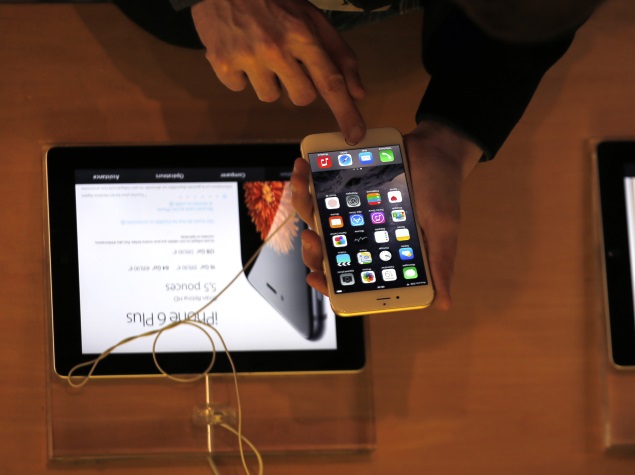
SO why bother? This feature is mainly useful when you want to let people glance through your entire collection of photos. That could be when you're sitting with a friend in the same room or making a presentation before a large audience. You can hide embarrassing or incriminating photos - such as naked selfies - as long as you remain in control of the device. If you hand it to a friend and walk out, your friend can browse through the albums section.
Samsung Galaxy devices
The Samsung Galaxy S5 (Review I Pictures) phone introduced a private mode. You turn it on in the settings, under "Private Mode" in the Personalization section.
You then go through your phone to mark certain content as private. With photos, for instance, just go to the Gallery app and select the photos or albums you want to keep private. Then hit the menu icon for the option to "Move to Private." This also works with selected video, music, audio recordings.
After you've marked your files as private, you need to go back to the settings to turn Private Mode off. Think of that setting as the door to a vault. Turning it on opens the door and lets you move stuff in and out. Turning it off closes and locks the door. It's the opposite of what you might think: Private Mode needs to be off for your content to be secure.
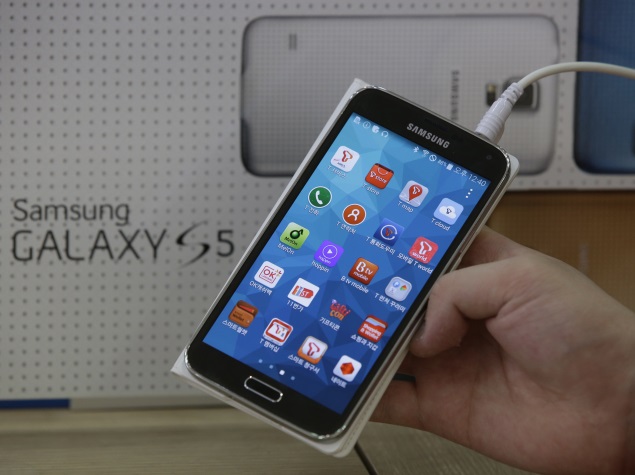
Once locked, it is as though the content never existed. No one will know what's inside the vault, or whether there's even anything inside. To unlock the vault, you need your passcode or fingerprint ID.
The private-mode feature is also part of Samsung's Galaxy Tab S tablets and the upcoming Galaxy Note phones.
LG G3
LG's flagship phone has a guest mode. You can lend a phone to a friend without giving your friend access to everything. You can even set a separate unlock code for the guest, so that you don't have to give out yours.
Look for "Guest mode" in the settings under the General tab. You then specify which apps your guest can access. For instance, you might want to give access to the phone, alarm clock and music, but you might want to block email and texts.
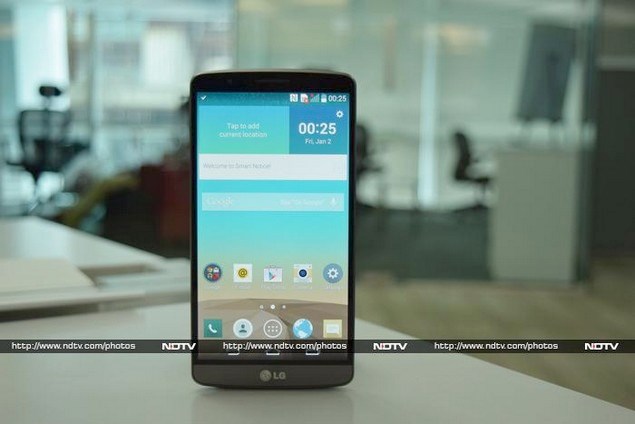
In some cases, guests have limited access to your content. With the Gallery app, your collection of photos won't generally appear unless they are in the "Guest album." Guests can take photos, too, and have them appear there. On the other hand, if you enable access to the Photos app, your guest gets everything. Likewise, there are no restrictions with email or texts if you allow access to those apps.
I recommend logging in as a guest - with the alternative code - to verify what's available after you pick the apps to allow.
Beyond the guest mode, the LG G3 (Review | Pictures) lets you lock certain images in the Gallery app during normal use, similar to what the Galaxy devices offer.
The bigger picture
These tips touch only the surface of what you can do to protect your privacy.
For instance, these apply only to data stored on the device. For files stored on Internet-based storage services such as iCloud and Dropbox, you'll want to make sure you have a strong password and turn on a second layer of protection, often known as two-step verification. I covered that in a previous column, which can be found here.
You'll also want to pay attention to what data you're sharing through apps.
With iOS, you can choose which apps can know your location and when, such as all the time or only when the app is actively running. Go to the "Location Services" settings under "Privacy." Unfortunately, it tends to be all or nothing with Android. You can turn off location services, but that affects all apps, including maps and others that might need your location.

Streaming is now the US music industry's biggest money maker It just edged out downloads in 2015.

Streaming is now the US music industry's biggest money maker

It just edged out downloads in 2015.


It may have just been a matter of time, but it finally happened: streaming music is now the biggest cash cow for the American music industry. The RIAA's latest year-end sales report reveals that streaming accounted for 34.3 percent of US music revenue in 2015, barely edging past the 34 percent of downloads. Physical sales, meanwhile, were down to 28.8 percent. And despite concerns about free listening hurting the bottom line, paid subscriptions were the star of the show. While ad-based streaming pulled in 30.6 percent more cash versus 2014, paid subscriptions jumped 52.3 percent -- suddenly, forking over $10 a month for unlimited music wasn't such a far-fetched idea.
The label-backed organization partly credits the boost to the rise of new entrants like Apple Music and Tidal. Streaming was simply the hot space last year, and everyone stood to gain whether they were fresh or an incumbent like Spotify. Internet radio (think Pandora and SiriusXM) and music videos also played roles, but only tiny ones. No matter what, online tunes were enough to offset the drop in demand for hard copies, as the entire industry's revenue grew a modest 0.9 percent.
It's hard to say that streaming will keep growing at the pace it has, since there are only so many people willing to either subscribe or put up with ads. Even so, the data might be enough to have labels changing how they distribute and push music. Rather than treat streaming as just one of multiple options, they may be more likely to steer you toward the on-demand services first and foremost.

Blind woman may see thanks to gene therapy and light Optogenetics are getting their first proper test in humans.

Blind woman may see thanks to gene therapy and light

Optogenetics are getting their first proper test in humans.


Optogenetics, or mixing gene therapy with light treatments, is finally getting a proper field test: doctors have given a blind Texas woman the first optogenetics-based therapy in hopes of restoring some of the vision lost to a degenerative retina disease. The procedure injected her eye with viruses containing DNA from light-sensitive algae, letting them mimic the eye's rods and cones by generating electricity whenever they're subjected to light. The patient won't get full vision even if the therapy is a runaway success, but it could be enough to let her know when there's nearby activity.
Whether or not this works is far from certain. Doctors are going to watch the woman's progress closely over the next year, and she may need up to three more treatments. The cells also can't adjust their light sensitivity the way a retina can, so a truly effective system might need video glasses that automatically tweak the image brightness as the wearer ventures indoors or outdoors. Even so, this promises to be a breakthrough -- it's less intrusive than the current solution, which implants a chip that stirs cell activity. Eventually, certain forms of blindness may be relatively easy to mitigate.

Big tech companies want to make email more secure Google, Microsoft and other tech corporations proposed a new email mechanism.

Big tech companies want to make email more secure

Google, Microsoft and other tech corporations proposed a new email mechanism.


Google, Microsoft, Yahoo, Comcast and LinkedIn have joined forces to create a new email mechanism that makes sure the messages you send are encrypted. In the proposal they've submitted to the Internet Engineering Task Force, these tech titans called their creation SMTP Strict Transport Security (SMTP STS). See, the underlying technology behind email has remained largely unchanged since it first became available. An encryption system was introduced some time ago -- and big email providers like Gmaildo use it -- but it's susceptible to man-in-the-middle attacks.
For instance, a hacker could insert a fake digital certificate, and the system would recognize it as authentic. That means you could end up sending email to an unsecured server without you knowing. Further, it could continue sending your message even if it detects that the server isn't secure.
The new system can prevent either scenario from happening. It checks if the domain you're sending to supports SMTP STS and makes sure its encryption certificate is authentic and up to date. If everything checks out, it allows your message to go through. But if it detects something suspicious, it will stop the email from sending and will notify you of the reason.
It's safe to say that the companies involved will incorporate the technology into their services if it gets approved -- it's their engineers' creation, after all. In that case, the encrypted messages sent out and received by Gmail could go up from 83 to 69 percent, respectively, to a hundred percent.

Graphene-based patch can help monitor blood sugar levels It can also deliver medication using tiny needles.

Graphene-based patch can help monitor blood sugar levels

It can also deliver medication using tiny needles.


This see-through patch made of graphene and studded with gold isn't just a fashion accessory or temporary tattoo. It has the capability to monitor your blood sugar levels and deliver diabetes medication. The prototype, designed by Seoul National University assistant professor Dae-Hyeong Kim and a team of researchers, has sensors that can detect your temperature and the pH/chemical composition of your sweat. It then beams the data it collects to an accompanying smartphone app. If the system infers that you need medicine based on the state of your sweat, the app computes for the amount of medication (metformin for type II diabetes) you need. The patch's microneedle array then injects the right amount into your body.
While it could save someone's life in the future, the current version is far from being a product people can rely on. At its current form, the microneedle array activates when the bracelet detects that the temperature's 105 degrees Fahrenheit. That makes it ill-suited for use in the tropics and other generally warm locations. Also, it's incapable of delivering enough metformin that adults need. The team still has to figure out how to fix that without having to create an enormous version filled to the brim with teensy needles.

Engadget giveaway: Win an mCookie Family Kit courtesy of Microduino! Easily add intelligence to LEGO creations and more.

Engadget giveaway: Win an mCookie Family Kit courtesy of Microduino!

Easily add intelligence to LEGO creations and more.


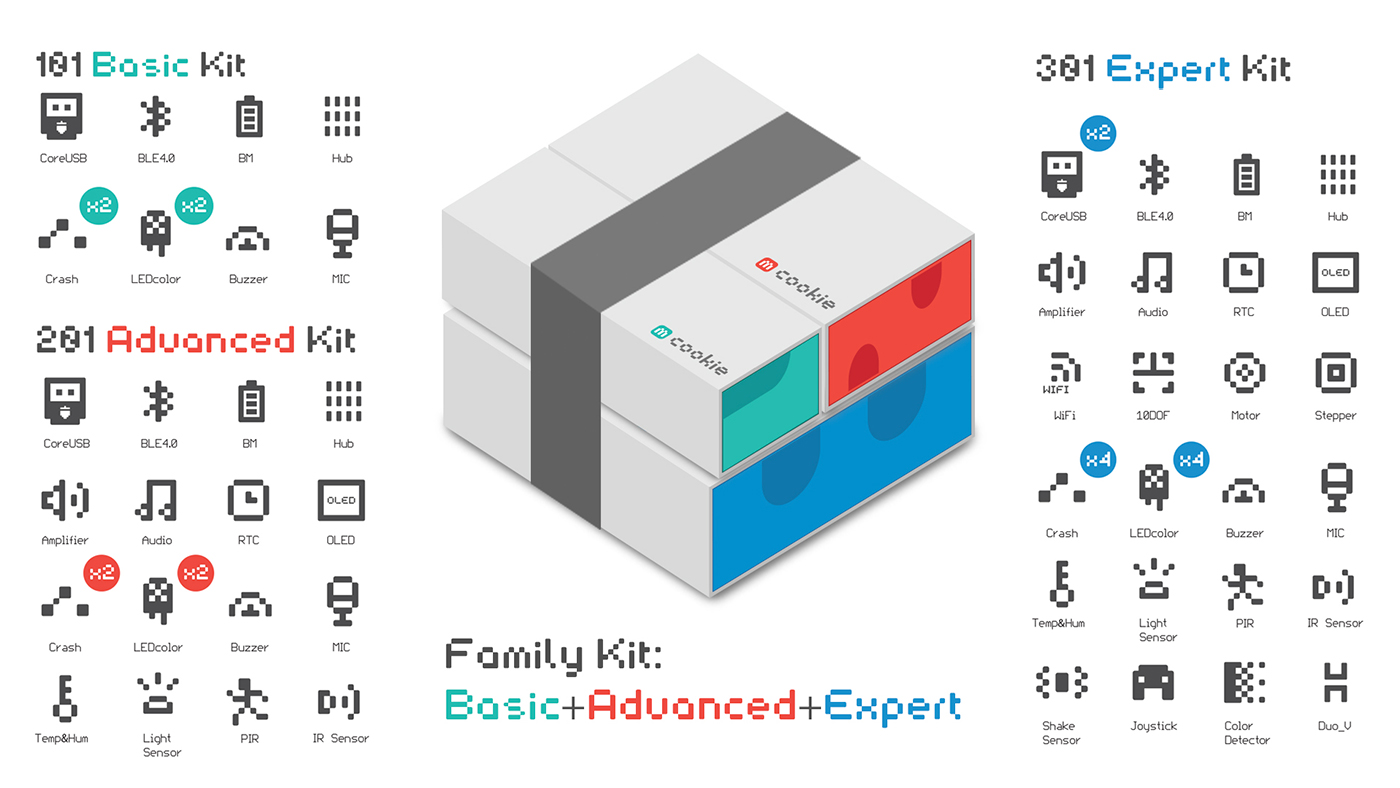
Getting your STEM skills up to speed is now easier than ever withMicroduino's mCookie. These Arduino-compatible electronics kits make building mini machines a snap -- literally -- with magnetic connectors andinterlocking pins that match up with LEGO blocks. The mCookie family of DIY modules, sensors and accessories was Kickstarted back in 2015 and began shipping to consumers at the end of the year. Now anyone can pick up one of the various kits (BasicAdvanced or Expert) and assemble projects like a music box, voice-activated camera, paw-waving fortune catand more. Microduino also offers additional components to expand the possibilities to keep pace with your imagination. This week, one lucky reader will win a Family Kit (including all three mCookie sets) to launch their smart-machine-making career. Just head down to the Rafflecopter widget below for up to three chances at winning.
  • Entries are handled through the Rafflecopter widget above. Comments are no longer accepted as valid methods of entry. You may enter without any obligation to social media accounts, though we may offer them as opportunities for extra entries. Your email address is required so we can get in touch with you if you win, but it will not be given to third parties.
  • Contest is open to all residents of the 50 States, the District of Columbia, and Canada (excluding Quebec), 18 or older! Sorry, we don't make this rule (we hate excluding anyone), so direct your anger at our lawyers and contest laws if you have to be mad.
  • Winners will be chosen randomly. One (1) winner will receive one (1) Microduino mCookie Family Kit (which includes the 101 Basic Kit, the 201 Advanced Kit and the 301 Expert Kit - $600 value).
  • If you are chosen, you will be notified by email. Winners must respond within three days of being contacted. If you do not respond within that period, another winner will be chosen. Make sure that the account you use to enter the contest includes your real name and a contact email. We do not track any of this information for marketing or third-party purposes.
  • This unit is purely for promotional giveaway. Engadget and AOL are not held liable to honor warranties, exchanges or customer service.
  • The full list of rules, in all its legalese glory, can be found here.
  • Entries can be submitted until March 23rd at 11:59PM ET. Good luck!

NASA's Dawn mission offers a closer look at the dwarf planet Ceres Enhanced color images shed light on the mysteries of Ceres' surface.

NASA's Dawn mission offers a closer look at the dwarf planet Ceres

Enhanced color images shed light on the mysteries of Ceres' surface.


If New Horizons is providing us tons of info about Pluto, the Dawn missionis helping us get to know Ceres a lot better. NASA has released new photos and information that the Dawn spacecraft took and gathered in its lowest orbit around the dwarf planet. They've recently found that the brightest area on the celestial body, a spot smack-dab in the center of the Occator Crater, has a dome inside a smooth-walled pit. You can see an image of the area above, which the agency enhanced to highlight the color differences of Ceres' surface.

The scientists think those white, vein-like growths inside the pit could indicate geologic activity in the "recent past," which still means a few million years ago or so. Dawn's other images also show that Ceres doesn't have as many large impact craters as scientists thought, and that there's one particular crater called Haulani that's composed of different materials than the rest of the dwarf planet.
Besides taking photos, the spacecraft used its Gamma Ray and Neutron Detector (GRaND) to measure Ceres' elemental composition. The instrument detected fewer neutrons near its poles, indicating a big amount of hydrogen concentration. It's a possible proof that there's ice -- the same ice made of water we're used to -- in its polar regions. NASA discusses these findings (and more) in the video below, while showing more photos of the largest object in the asteroid belt.

Orbital rocket ready to launch its biggest ISS cargo ever After they unload Cygnus, the astronauts will deliberately set it on fire.

Orbital rocket ready to launch its biggest ISS cargo ever

After they unload Cygnus, the astronauts will deliberately set it on fire.


A resupply ship from Orbital ATK is ready to launch its largest cargo ever to the International Space Station. The newly redesigned Cygnus craft, first launched in December, is capable of carrying 25 percent more payload than before, and today's weighs nearly four tons. "It's like opening a box of goodies and finding some stuff you've been wanting and some surprises you didn't know about," says Orbital's Dan Tani, a former ISS astronaut. Along with the supplies, Cygnus will carry a 3D printer from Made in Space, two dozen nanosatellites and Saffire, an experiment to test the effects of fire in space.


The Saffire experiments are scheduled to run after all the cargo is unloaded. Fire is obviously a serious hazard in space, so the goal is to safely study how it propagates in zero-gravity. Normally, the crew would just load Cygnus with trash and lets it burn up on re-entry into the atmosphere. This time, however, it will remotely ignite a piece of cloth inside a five-foot-wide module to study how fire behaves in a micro-gravity environment.
If all goes well, Cygnus will launch today at 11:05 PM eastern time, with a 30 minute launch window extension. It will dock with the ISS on March 26th and the Saffire experiment will happen at some point after that, though NASA hasn't said when yet, exactly. Once the experiment is complete, it will remain in orbit seven days while scientists download data from sensors and video cameras. After that, they'll send Cygnus off to burn up on re-entry as usual.

Table Salt Can Eliminate This Crippling Disease By 2020

Table Salt Can Eliminate This Crippling Disease By 2020


To help Haiti eliminate lymphatic filariasis, a disease that affects nearly half of its population, Cargill teams up with the Reverend Thomas Streit C.S.C. and the University of Notre Dame’s Haiti Program.

When Jim Reimer retired, he did not anticipate the important role he and the company would play in helping millions of Haitians combat a terrible disease. In 2012, Reimer became involved in the University of Notre Dame’s Haiti Program, which works to rid Haiti of lymphatic filariasis (LF) by 2020.
LF is a disease spread by mosquitos that can lead to the extreme swelling of various body parts. It also carries a cultural stigma, which can result in victims being shunned and excluded from their communities. Despite its devastating effects, LF is one of only a few infectious diseases that have the potential to be completely eliminated. Knowing this, Reimer, a former Cargill executive, and a team of Cargill employees partnered with the Reverend Thomas Streit C.S.C., the founder of the University of Notre Dame Haiti Program, to work toward this goal.
The solution came in the form of a common food: salt. Everyone eats salt on a regular basis, so delivering medication by fortifying salt proved to be an effective way to fight the disease.
Because Haitians typically consume a type of salt that contains many impurities, it was difficult to add the medication successfully. To overcome the production challenges, Cargill worked with the University’s Haiti Program, providing technical expertise as well as US $150,000 in donations over a three-year period.
Current efforts to defeat LF have positioned the program to meet its goal of ending the disease in Haiti by 2020. A new salt processing plant located near the country’s capital is run by the Congregation of the Holy Cross to help with the large-scale production of fortified salt. The salt treatment method also offers the opportunity to address several other health issues in Haiti, including working to correct an endemic iodine deficiency, reducing other parasites like hookworm that can harm children and strengthening Haiti’s public health infrastructure.

50 best Android games 2016: our top picks

50 best Android games 2016: our top picks


While the 'free-to-play' market has taken a bit of a beating of late due to gamers falling out of love with the use of in-app payments, the world of mobile gaming is still an exciting one.
Whether you want games that will last the length of a commute, or want to be lost in a port of GTA where you spend hours mowing down pedestrians and making money out of murder, there is a game on here for you.
This constantly updated list is a mixture of free and paid for games, and also that one in between - some in-app payments aren't really that bad. Honest! If by the end you think we have missed something special off of the list, let us know and we will see if it is worthy of inclusion further down the line.
Oh, and just so you know, we do play the games we test - so you can have confidence in our selection.

Jolla Tablet can now be pre ordered by Indian customers

Jolla Tablet can now be pre ordered by Indian customers


The Jolla Tablet was initially available on Indiegogo as a crowd funded project. Following the initial wave of funding however, the company announced the tablet for a wide range of markets. Jolla's new wave of launch covers a number of key global markets including the India, the US, Hong Kong, Norway, Switzerland, Australia, Canada and regions of the EU.

The tablet has been priced at 267 or Rs 20,100 for the 32GB model and 299 or Rs 22,800 for the 64GB model. Pre orders will begin shipping in late October, so you can't have the Jolla Tablet right away. Pre orders of the tablet should start shipping within a week according to the company.

The company is only selling the standard Wi-Fi only model of the Jolla Tablet with no cellular model in sight. At this price point, the Jolla Tablet could compete with some of the veterans of the tablet industry like Samsung, Apple etc, although there are cheaper tablets out there from manufacturers like Xiaomi, Micromax and others.

Despite featuring the Sailfish OS, the Jolla Tablet can run full blown Android apps with ease, which makes it a versatile mobile platform.

Hardware specifications of the Jolla Tablet:

· 7.85-inch 2048x1536 display
· 8.3mm thickness
· 384 grams
· 1.8 GHz quad core Intel Atom processor
· 5MP rear camera, 2MP front camera
· 2GB of RAM
· 32/64GB of storage (microSD support)
· Sailfish OS v2.0
· 4,450 mAh battery
· Wi-Fi, Bluetooth 4.0

Tesla Ludicrous Mode now available as retrofit for Model S P90D Did you pass on Ludicrous Mode when you ordered your P90D? You can add it now.

Tesla Ludicrous Mode now available as retrofit for Model S P90D

Did you pass on Ludicrous Mode when you ordered your P90D? You can add it now.


When Tesla first introduced the Model S P90D with Ludicrous Mode, P85D owners no longer had the top-of-the-line performance version of the electric sedan. To make it up to owners, Tesla eventually offered a discounted Ludicrous Mode retrofit for the P85D (priced at $5,000, rather than the $10,000 upgrade in the P90D). The Ludicrous Mode upgrade for the P90D was only available when configuring the vehicle - you snooze, you lose. Not anymore, though, as Tesla is now extending the option of aLudicrous Mode retrofit to P90D owners who passed on the upgrade when originally ordering the car.
The P90D retrofit costs the full $10,000, plus whatever taxes and labor costs are involved with its installation. The upgrade, as Electrek details it, replaces the standard fuse with an "advanced smart fuse" that monitors and manages current more precisely (to the millisecond). The main steel battery pack contactor gets replaced with the same Iconel superalloy thatElon Musk's other venture, SpaceX, uses for its SuperDraco rocket engine. Combined, the changes increase the maximum output from 1,300 to 1,500 amps, which translates to better performance from the car.
The result: the upgraded P90D sheds 10 percent of its 0-60 miles per hour time, dropping it down to 2.8 seconds. Tesla puts the updated quarter-mile time at 10.9 seconds, and says the time to 155 mph is "20 percent faster than a standard Model S Performance."
And, of course, Tesla doesn't leave out the all-important underline to the P90D badge. Somehow, it just wouldn't feel as fast without it.

Google Drive for Android gets a file editing shortcut Just tap the blue button at the bottom of the screen.

Google Drive for Android gets a file editing shortcut

Just tap the blue button at the bottom of the screen.


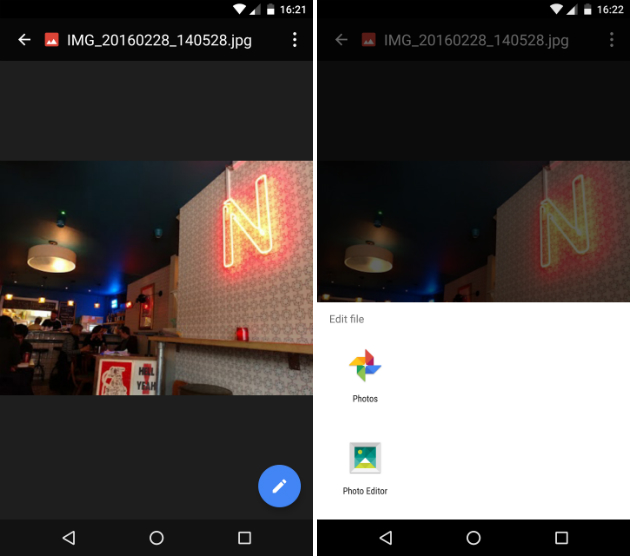
Many people adopt Google Drive because they're already invested in the company's other products, like Docs and Photos. They all play nice with one another, however on Android the Drive app is mostly a management tool -- to do some actual editing, you often need to open another app. To make your life a little easier, Google has added an editor shortcut to file previews. Just open a document or photo in Drive, tap the blue button and you can jump directly into another editing app installed on your phone.


In a blog post, Google mentions that "some common editor apps include Google Photos, Google Docs, and more." Other apps are definitely supported -- on my Moto X Style, for instance, I have the option to choose between Google Photos and Motorola's own photo editor. Such an addition, while small, should make Google Drive simpler and faster to use for Android users. It should also make Google's productivity suite feel more like a cohesive whole, and less like a series of siloed products.
On a separate note, the latest version of the Drive for Android app also adds the ability to reverse sort your files. Just tap the downward facing arrow that's visible in the top right-hand corner of the screen. Voila!


Google is giving Chrome's app launcher the axe The Chromium team says it's in an effort to further streamline the browser.

Google is giving Chrome's app launcher the axe

The Chromium team says it's in an effort to further streamline the browser.


Folks who favor launching Chrome apps from their dock on OSX or the taskbar on Windows rather than through the browser itself are bound to be disappointed by today's news. Google has announced that the Chrome App Launcher will be removed from the Apple, Linux and Microsoft operating systems. It's still safe on Chrome OS, though.
The internet juggernaut says that the removal will take place gradually over the coming months, starting with disabling the launcher upon initially installing a new application in a few weeks. The full-on end point is July -- three years after the launcher hit Windows. And in case your friends don't read Engadget, Google says it'll notify users that the launcher is going the way of the Tyrannosaurus.
It's part of Google's moves to make its browser less bloated, with the blog post explicitly citing last summer's removal of the Chrome notification center as an example of those efforts. Here's to hoping that some of this results in the browser being less of a resource hog that strains even themost resilient ultrabook's battery life.